|
|
||
|
|||
|
|||
 |
 |
||
|
|||
|
BeatificationThe first and often most difficult step is beatification. The promoters of the cause are asked to vouch for four authentic miracles in order to secure beatification. One miracle can be dispensed if the candidate has founded a religious order. In Joan’s case, the Pope granted dispensation because she had saved France. This seemed fair enough! So then, three approved miracles were necessary for Joan’s beatification. Three nuns, all living in France, received documented cures attributed to Joan of Arc’s intervention. These miracles were accepted as authentic. Once a person is beatified (or declared blessed), the faithful
are allowed to venerate these individuals. However, this is not universally recognized and
usually limited to the towns connected to the person. CanonizationThe next step, once beatification has been declared, is canonization. Two more miracles must be proven for canonization. Two such miracles were attributed to Joan of Arc which sealed her sainthood—a healing from tuberculosis and the healing of a hole in the sole of a woman’s foot.
Joan of Arc's Journey to Sainthood
Trial of RehabilitationPolitics obviously influenced this new trial; however, this doesn’t alter the fact that the Trial of Rehabilitation brought much evidence to light, clearly proving the illegality and numerous errors in procedure of the first trial. The new trial, the Trial of Rehabilitation, was opened
in Paris on November 7, 1455. Four examinations were held, one in Domrèmy,
Rouen, Orléans and
Paris, with one hundred and fifty witnesses heard.
The verdict declared the Trial of Condemnation
from 1431 was invalid on the grounds of procedure and the judges having lacked impartiality. In the Old Market
Square in Rouen, where Joan had been burned, a cross was raised in honor of
her injustice. The Trial of Rehabilitation was the first step in clearing
Joan’s good name. The evolution of her reputation from witch to holy maid
had begun. Petitioning Pope Pius IXFour hundred fourteen years later, in 1869, Bishop Dupanloup of Orléans had the ingenious idea of inviting all the bishops of the towns which Joan had marched through on her way to Reims to the annual May 8 commemoration of the town’s liberation. The Bishop made an emotional speech about the importance of Joan as a patriot and a Catholic. The eleven bishops present, along with Bishop Dupanloup, made a solemn appeal to Pope Pius IX in Rome to begin the process of canonization. Their appeal was the following:
In 1894, Rome began its work towards the Bishops’
petition. Joan’s beatification was decreed by Pope Pius X on April 11, 1909.
|
|||
|
go on to Prayers and Poems to Saint Joan >>|Home| |Back to Top| |Contact Us| |Copyright ©| |Privacy Policy| |Site Map|
|
|
|







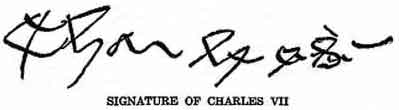 Joan’s journey to sainthood started in the year 1449, when
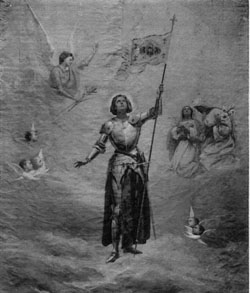 Saint Joan of Arc